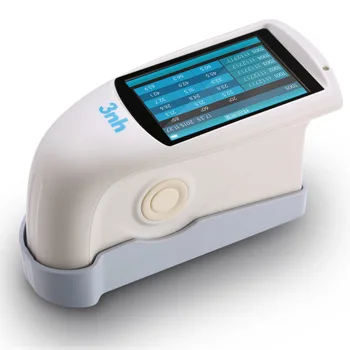
HG-Series Digital Gloss Meter
The HG digital gloss meter series (HG268, HG60, HG60S) — 20°/60°/85° or 60°-only measurement, repeatability from 0.1 GU, an economical alternative to the NHG series.
- Gloss measurement at 20°, 60° and 85° (HG268) or 60° only (HG60, HG60S)
- Repeatability around 0.1 GU (1 GU on the entry-level HG60S)
- Large colour display and one-button measurement
- PC connectivity on HG268 and HG60 (not available on the entry-level HG60S)
The HG series comprises digital gloss meters that measure gloss at 20°, 60° and 85° (the HG268 model) or at 60° only (the HG60 and HG60S models). The HG60S is the most basic variant — a 0–200 GU range, roughly 1 GU repeatability, and no internal memory or PC connectivity — making it an economical option where the full feature set of the NHG series is not required.
Results are shown in Gloss Units (GU) on a large colour display, and a single button triggers a reading. The HG268 and HG60 models connect to a PC and run on GQC6 software, which can print reports. The HG series complies with ISO 2813, ASTM D523, ASTM D2457 and GB/T 9754.
Key specifications
| Parameter | Value |
|---|---|
| Variants / angles | HG268: 20°, 60°, 85°; HG60 and HG60S: 60° |
| Measuring spot | 20°: 10 × 10 mm; 60°: 9 × 15 mm; 85°: 5 × 36 mm |
| Measuring range | HG268/HG60: 0–1000 GU (85°: 0–160 GU); HG60S: 0–200 GU |
| Repeatability | ± 0.1–0.2 GU (HG268, HG60); ± 1 GU (HG60S) |
| Reproducibility | ± 0.2–0.5 GU (HG268, HG60) |
| Reading error | ± 1.5% (HG268, HG60) |
| Chromaticity | matches CIE 1931 (2°) using a CIE C light source |
| Standards compliance | ISO 2813, ASTM D523, ASTM D2457, GB/T 9754 |
| Measurement time | 0.1 s (HG268, HG60); 0.5 s (HG60S) |
| Memory | 1,000 readings (HG268, HG60); none on HG60S |
| Software | GQC6 (HG268, HG60); none on HG60S |
| Power | 3200 mAh Li-ion battery, over 10,000 measurements per 8 h charge |
| Operating conditions | 0–40°C, relative humidity < 85% |
| Dimensions / weight | 160 × 75 × 90 mm / 350 g |
Applications
HG gloss meters are used industrially to measure the gloss of printing inks, oil-based paints, varnishes, coatings and primers, as well as decorative construction materials such as marble, granite, chemically polished glass and ceramics. They also perform well in gloss control of plastics and other polymer materials, particularly where a simple, economical gloss check is all that is needed.
For the complete technical specification, see the PDF datasheet. Need help matching an instrument to your application? Request a quote — we will help you choose the right configuration and accessories.