Colour measurement in the textile industry
Objective control of dyeing, batch consistency and colour fastness of fabrics — instead of eyeballing.
Why measure fabric colour
In dyeing and finishing, repeatability is everything: the same recipe must give the same colour in every batch, on different substrates and under different lighting. Visual colour assessment is subjective and observer-dependent — which is why quality control relies on colour difference ΔE in the CIE L*a*b* space.
Lab recipe control and batch consistency call for spectrophotometers with a full reflectance curve and SCI/SCE modes, while fast on-line checks use colorimeters. Metamerism — colours that match under one light but differ under another — is assessed in a colour assessment cabinet with standardised D65, TL84 and CWF light sources.
Objective measurement reduces complaints, simplifies communication with customers (“ΔE < 1”) and keeps colour fastness and fabric-to-standard consistency under control.
Instruments for textile applications
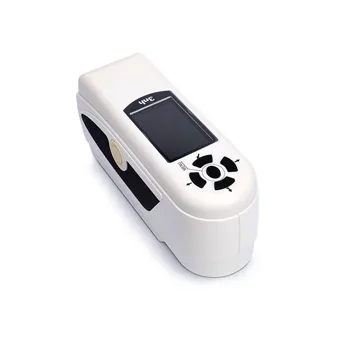
kolorymetry
NH310 Colorimeter
An 8/d colorimeter with simultaneous SCI and SCE measurement, two apertures (Φ8/4 mm) and camera-assisted point location — for advanced colour-difference, yellowness and whiteness control.
- Simultaneous SCI and SCE measurement — assess the effect of the specular component
- Two measuring apertures, Φ8 mm and Φ4 mm
- Stable, horizontal housing plus camera-assisted measurement-point location
- Built-in calibration tile with automatic calibration before each session
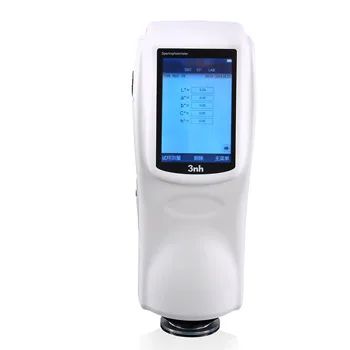
spektrofotometry
NS810 Sphere Spectrophotometer
Portable d/8° sphere spectrophotometer with SCI measurement — Φ58 mm integrating sphere, ΔE*ab 0.04 repeatability and a full reflectance curve for colour control in the field or on the line.
- d/8° sphere geometry with a Φ58 mm integrating sphere, SCI measurement regardless of sample gloss
- ΔE*ab 0.04 repeatability and ΔE*ab ≤ 0.2 inter-instrument agreement
- Full 400–700 nm reflectance curve and the complete set of colour-difference formulas
- 3.5" touchscreen, 1,000 standards / 15,000 sample memory, USB and RS-232
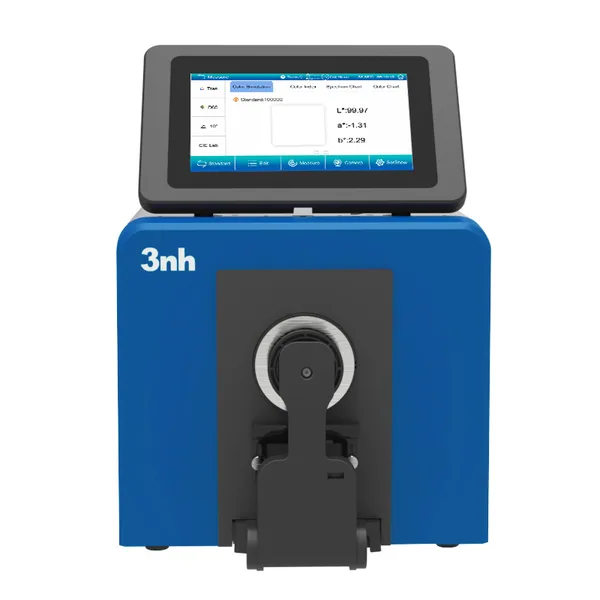
spektrofotometry
TS8560 Benchtop Spectrophotometer (LED + xenon)
A flagship benchtop spectrophotometer with dual LED + xenon light sources, reflectance and transmittance (haze) measurement and a Φ154 mm sphere — with a rotatable 7" screen, 32 GB storage and automatic temperature/humidity compensation.
- Dual light source LED + xenon lamp — better identification of fluorescent samples
- Reflectance (SCI/SCE) and transmittance plus haze (per ASTM D1003) in a single instrument
- Four aperture ranges (XLAV/LAV/MAV/SAV) and a transmission chamber for samples up to 54 mm thick
- Rotatable 7" touchscreen, 32 GB storage, camera positioning, temperature/humidity compensation
Frequently asked questions
Which instrument should I choose for fabric colour control?
For recipe control and top accuracy — a sphere spectrophotometer with SCI/SCE modes, ideally a benchtop unit (e.g. TS8560). For fast batch-consistency checks on the line, a colorimeter (e.g. NH310) is enough.
What is metamerism and how do I control it?
Metamerism is when two samples look identical under one light but differ under another. It is controlled by assessing samples in a light cabinet under several standardised sources (D65, TL84, CWF) and by measuring colour under multiple illuminants.