Colour measurement of plastics
Pigment matching, moulding consistency and product colour control — objectively and in numbers.
Colour in plastics production
The colour of pellets, mouldings and profiles must match the standard regardless of raw-material batch and processing parameters. Pigment variation, colourant dispersion and surface gloss all affect the final look — and subjective eyeballing misses small but visible deviations.
Plastics colour control uses spectrophotometers and colorimeters that report colour as difference ΔE in the CIE L*a*b* space. For glossy parts, gloss matters too — measured with a gloss meter at 20°/60°/85° per ISO 2813. Combining colour and gloss gives full, repeatable appearance control.
Objective measurement simplifies pigment-recipe matching, speeds up batch approval and cuts waste caused by colour mismatch.
Instruments for plastics colour control
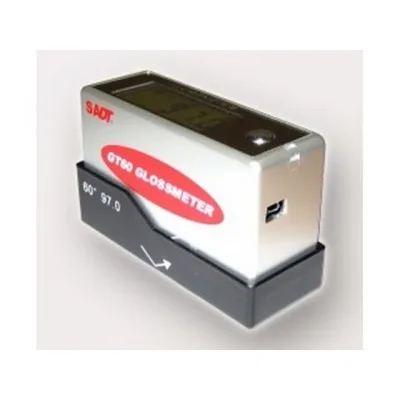
polyskomierze
GT60S Mini Gloss Meter
A light, compact 60° mini gloss meter for small and curved surfaces — Φ4 mm measuring window, 2×2 mm measured area, compliant with ISO 2813 / ASTM D523 / DIN 67530.
- 60° gloss measurement on small and curved surfaces
- Very small 2×2 mm measured area through a Φ4 mm measuring window
- Light, compact design that is easy to carry around
- Compliant with ISO 2813, ASTM D523 and DIN 67530
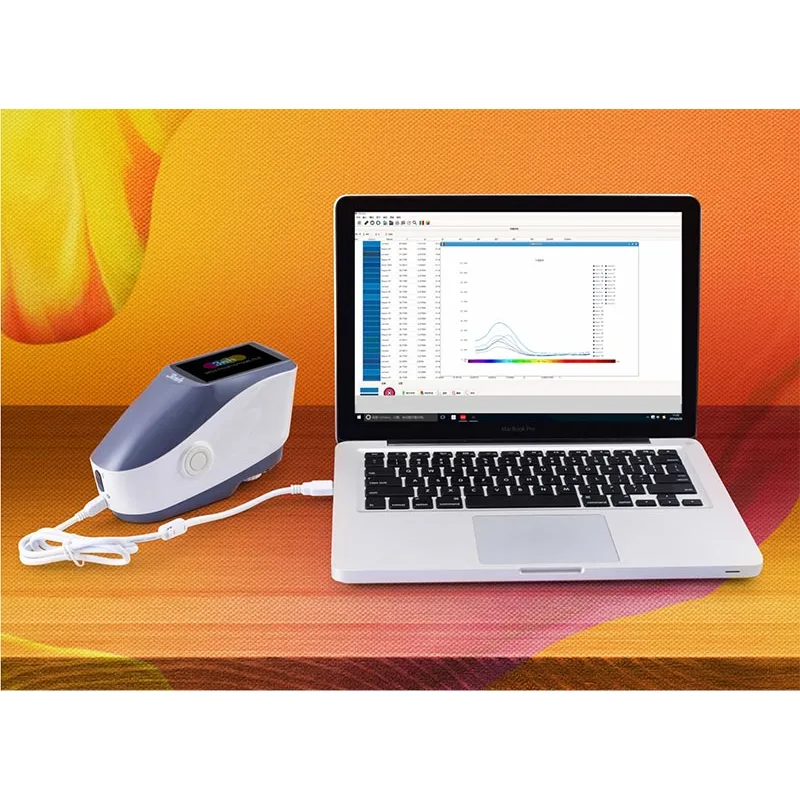
dopasowanie-koloru
PeColor Color Matching System
Professional computer colour-matching software — automatic and manual recipe formulation, batch correction and colour quality control for printing, paint, coatings, plastics, textiles, ceramics and automotive.
- Colour quality control with automatic pass/fail based on L*, a*, b* and ΔE*
- Automatic and manual recipe formulation with a choice of 1–6 colorants
- Formulation by combination — selects the optimal recipe for quality, cost and metamerism
- Colorant characterisation and automatic recipe correction after raw-material or process changes
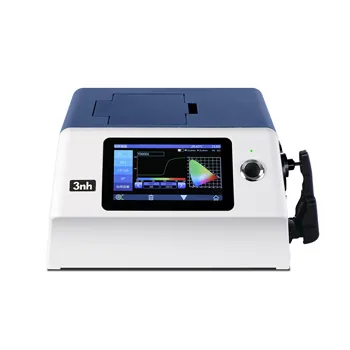
spektrofotometry
YS6060 Benchtop Spectrophotometer
A laboratory benchtop spectrophotometer with d/8° geometry and simultaneous SCI/SCE — measuring both reflectance and transmittance (haze), with a Φ154 mm sphere, 360–780 nm range and a 7" touchscreen.
- Reflectance AND transmittance (haze per ASTM D1003) in a single benchtop instrument
- d/8° geometry with simultaneous SCI/SCE, Φ154 mm integrating sphere, 360–780 nm range
- ΔE*ab 0.01 repeatability and ΔE*ab 0.12 inter-instrument agreement (12 BCRA tiles)
- Rich industrial index set — WI, YI, Gardner, APHA/Pt-Co, ASTM D1500, pharmacopoeia, EBC, ICUMSA
Frequently asked questions
Is a colorimeter enough for plastics, or do I need a spectrophotometer?
Simple batch-consistency control is fine with a colorimeter. Building and controlling pigment recipes, and working with difficult colours (metallics, effects), calls for a spectrophotometer with a full reflectance curve.
Why measure the gloss of plastics?
The same colour looks different at different gloss levels. Gloss measurement (ISO 2813) complements colour measurement and lets you control the full surface appearance of the product.